Where Ear Pro went
SUS4 Ear Pro was withdrawn from the App Store on 8 October 2026. Its 20-chapter, 172-lesson course and its Sound Engineer drills now live inside Ear Daily, in the Lessons tab, with spaced-repetition Review beside them. If you were an Ear Pro user, this routine is the Ear Daily way of doing the same work.
Train: one drill type, with your answer committed
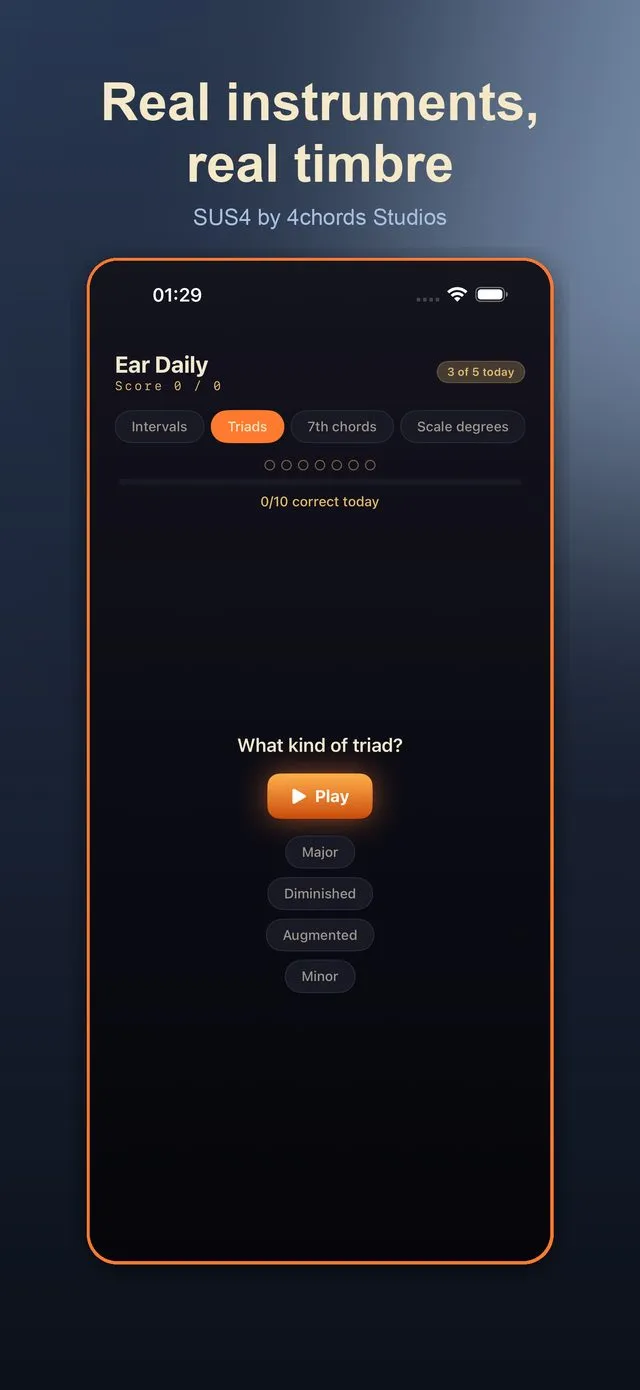
Train is the drill tab. Along the top you choose what to practise: Intervals, Triads, 7th chords or Scale degrees. Each drill is a handful of questions: tap Play, listen, choose an answer, and the app tells you straight away whether you were right, and what the answer was if not.
Stay with one drill type for a week rather than hopping between all four. The commonest mistake is to switch as soon as something feels hard. Hard is where the learning is. Scale degrees is the drill that carries over most to playing by ear, because it trains you to hear where a note sits in the key. It is what you are doing whenever you pick a melody out of a song.
Commit before you tap. Sing or hum the sound back first, then answer. If you tap while you are still guessing, you are training your thumb.
Lessons: the Ear Course and Sound Engineer
The Lessons tab has a switch at the top between Ear Course and Sound Engineer. The Ear Course is 172 lessons in 20 chapters, from octaves and thirds through extended chords, modes and melodic dictation. Everyone gets the first chapter free.
Sound Engineer is for people who mix: it asks you to name frequencies, EQ bands, reverb times and compression ratios by ear. If you are working through the mixing guides on this site, it is the same skill: knowing what a few dB at 3 kHz sounds like before you reach for the EQ. Alternate it with the Ear Course through the week.
Review: the things you keep getting wrong
Review reads from your answers. It shows how many facts are due for review and lists your weakest facts, and what you keep missing comes back on a spaced schedule. Do this part even when it is not fun: it is the part that fixes your actual mistakes rather than the questions you already know. Review also holds custom lessons, where you choose up to ten lesson types for yourself, and theory cards.
If Review is empty, do some Train or Lessons first. It needs your answers to work from.
Planning around the free allowance
Everyone gets the first chapter of the course, plus five a day shared by the drills, the other chapters and Sound Engineer. Pro, or SUS4 All-Access, removes the daily limit. On the free allowance, think of the day as five goes: for example, two Train drills, one lesson, one Sound Engineer or Review session, and one spare for when the first drill goes badly.
The 1.3.0 release also added a short timed drill every day, built from the course questions, which you can start from the Train screen. Your best scores are kept, so it doubles as a weekly check.
Checking that it is working
Look at Progress once a week, not every day. The accuracy chart covers 30 days, so a bad day will not show. You are looking for a gradual rise, and for which drill types are lagging. If accuracy has gone flat on one drill, slow down rather than speeding up: take five questions, answer them all after singing, and check which two answers you confuse. For intervals the usual pairs are the tritone and the perfect fifth, and the major sixth and minor seventh. Spend the next few sessions on the confusable pair.
The real test is outside the app. Pick a simple melody you know, work out the first four notes by ear on your instrument, and check them against the recording. If you can, you have gained something the streak counter cannot measure. When you want to go further, the Transcribe guide shows how to use that ear to check and correct a machine’s first draft of a part.